Our Academic Philosophy
At Pan African Global Academy, we believe education should inspire curiosity, creativity and critical thinking. Our STEAM-based curriculum combines academic excellence with hands-on, project-based learning to prepare students for higher education and lifelong success.
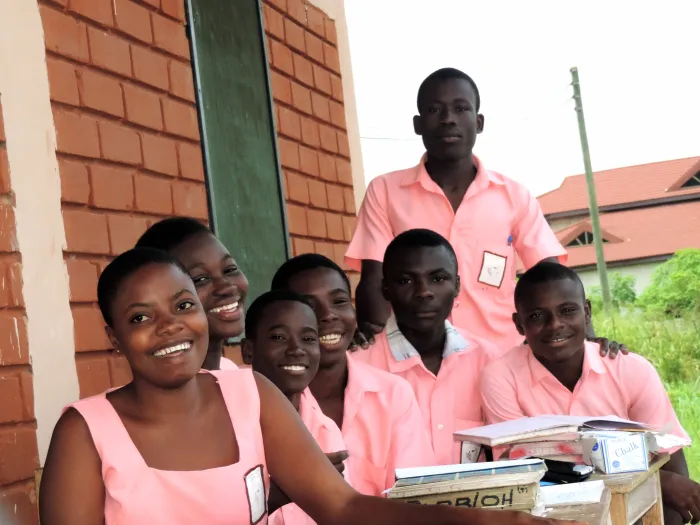
STEAM Education
Following the STEAM model, Pan African Global Academy offers a rich three-year curriculum that integrates Science, Technology, Engineering, Arts and Mathematics.
During the first three years, students participate in exploratory, project-based learning that exposes them to multiple disciplines while building creativity, collaboration and problem-solving skills.
Students then specialise in an elective pathway while continuing the core curriculum before entering an intensive fourth year focused on preparation for the West African Senior School Certificate Examination (WASSCE).
Core Curriculum
Pan African Global Academy provides a comprehensive core curriculum designed to develop students' academic knowledge, critical thinking, problem-solving abilities and practical skills for future success.
The English language curriculum covers four aspects of English. Students develop skills in oral English, reading and comprehension, grammar, writing and literature.
The first is oral English, which teaches students how to pronounce words correctly, especially words with vowel sounds and diphthongs. The second part is reading and comprehension, which encourages students to read as many books as possible. This part also teaches the techniques used in reading like skimming. It also requires that students be taught how to summarize and answer questions on what they read. The third part is grammar, which teaches about the structure of English language, how to put words together and the categories of words and phrases in the English language. The fourth, which is writing, requires that the students be taught how to write different kinds of essays like letters, stories and reports. The last aspect, literature, is about the different kinds of literature available and how to identify them. It also teaches some literary terms. The curriculum uses prescribed books for prose, poetry and drama to help students learn how to analyze literature. The students will be tested on those books at the end of their course.
This course emphasizes basic mathematical skills and develops students' computational and analytical abilities.
This course emphasizes basic mathematical skills. The major topics covered include Numbers and Numeration, Plane Geometry, Mensuration, Algebra, Statistics and Probability, Trigonometry, Vectors and Transformation in a Plane, as well as basic problem solving and application (mathematical processes). This course is structured to help students develop computational and analytical skills; to use mathematical knowledge in the context of everyday situations; to develop the ability to translate word problems (story problems) into mathematical language; and to organize, interpret and present information accurately in written, graphical and diagrammatic forms.
Integrated Science applies scientific theories to everyday life through inquiry-based and project-based learning.
This subject covers the application of basic theories in chemistry, biology, physics and environmental science to everyday life. At PAGA Integrated Science forms one of the bases for our project-based, inquiry based curriculum. Students apply what they learn in integrated science to development projects around the community and campus.
The Public Health curriculum forms the basis for the Social Studies curriculum in Form 3 by teaching students about the relationship between health and society.
The curriculum teaches students about the relationships between health and society. Topics covered include epidemiology, environmental health, nutrition, social health, health economics, community health, and national health. Field trips to local health clinics and pharmacies help student develop health intervention programs for their communities.
Social Studies equips students with knowledge of society, leadership, culture, governance and responsible citizenship.
The Social Studies curriculum represents a multi-disciplinary subject, which inherits ideologies and principles from several fields of study such as sociology, geography, psychology, economics, history and civic education. With specific emphases on the nature of society, Social Studies equips students with adequate knowledge of leadership, culture and political governance, ensuring that each individual possesses the necessary tools to fit into society and effect societal change. This course facilitates higher level understanding of the society by exploring the inner workings of the society, helping students adapt to the society and enabling the student to attain consciousness of the developmental needs of their societies and how those needs can be fulfilled. Topics range from discussions of sexual reproductive health in adolescents, Ghana’s participation in the international community, socio-cultural practices, democracy, and resource development.